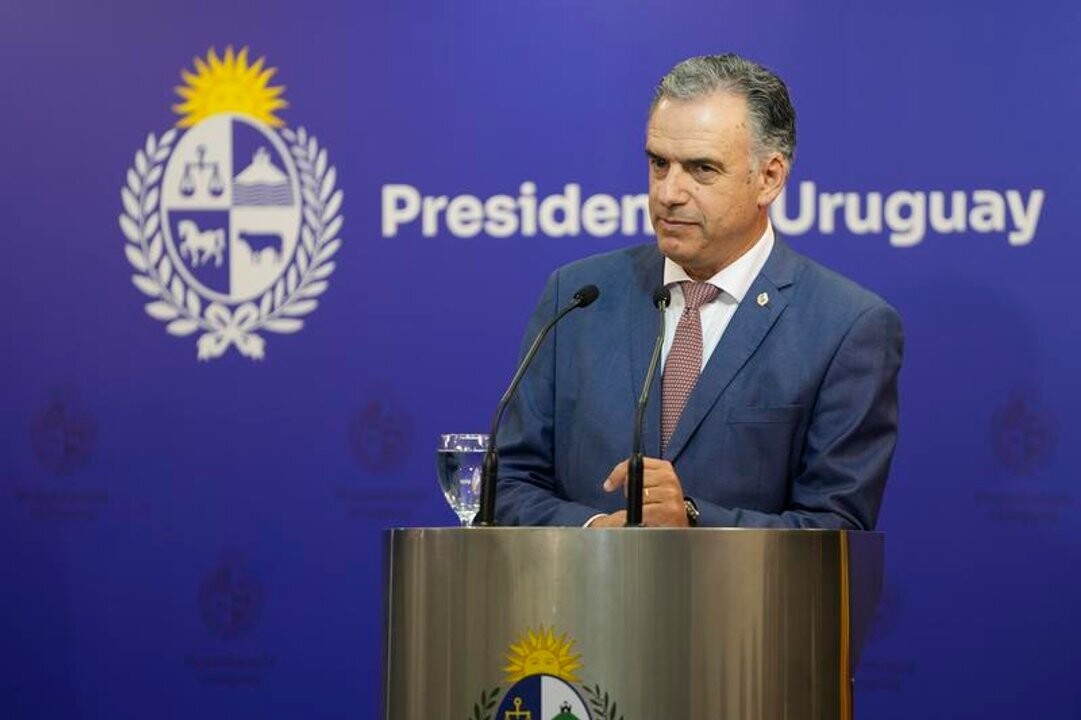
The president of Uruguay, Yamandú Orsi, has defended his government approach, which he has dubbed the "revolution of simple things," describing it as a series of "practical transformations" designed to improve citizens' daily lives.
During a lunch organized by the Association of Marketing Directors (ADM), the head of state, who took office on March 1, reviewed his first nine months in office and assured that the axes of his government are thought of "from the everyday".
"To govern is to resolve, to facilitate, and to make things work better every day and for all people," he stated before cabinet members, officials, and businessmen. Orsi illustrated his philosophy with concrete actions such as "a simplified procedure, a scholarship that arrives on time, a reduced wait in the health system, or a coordination that prevents the State from tripping over itself."
The government reported that out of the 63 priorities agreed upon in the first Council of Ministers, 44 commitments are already in implementation, with constant monitoring so that the plan is "living, measured, and corrected when necessary."
Orsi, a 58-year-old history professor, acknowledged that "some of the most important news regarding the president's figure has been the number of discursive stumbles," but defended himself with his teaching vocation: "if it is not understood, it is explained."
"Politically correctness, I confess, has me a bit tired. I am going to be myself and say what I think time and again," Orsi concluded, making it clear his intention to maintain a direct communication style.
Finally, referring to the legacy left by the government of Luis Lacalle Pou (National Party, 2020-2025), Orsi was balanced in saying that "it was not a disaster," but "it was not paradise either."