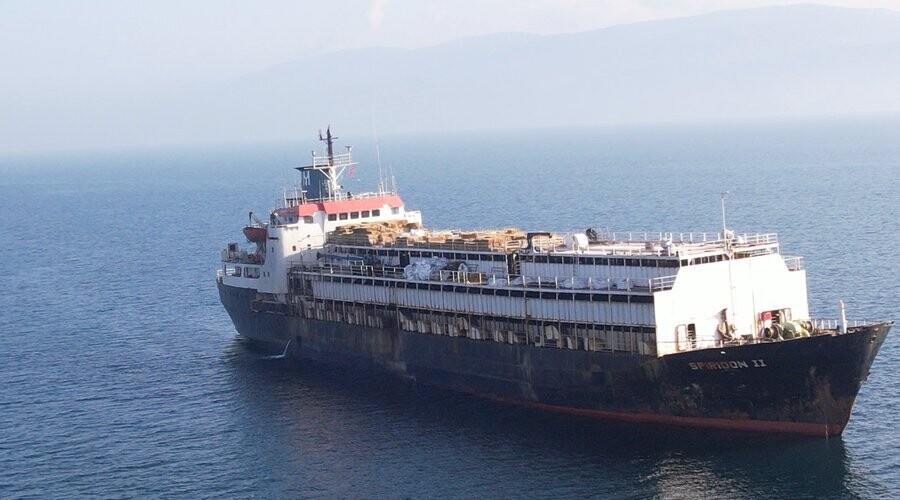
Istanbul, November 16, 2025 – Total News Agency-TNA- The veteran livestock carrier Spiridon II, with nearly three thousand Uruguayan cows on board, has departed Turkish waters on a return voyage fraught with uncertainty to Montevideo, following a diplomatic stalemate that has exposed the cracks in international live animal trade. In Uruguay, where meat exports represent 10% of GDP, the episode has sparked a domestic debate on tightening controls, even as neighbors like Argentina consider reopening similar routes. As the Spiridon II disappears into the vastness of the Mediterranean, it carries not just cargo, but a grim testament to the human—and in this case, bovine—cost of trade. As the vessel heads west, projections place its arrival at port around December 14—extending the total voyage to 87 days, a period veterinary experts warn could be lethal for much of the herd. Conditions aboard the Spiridon II have deteriorated into a panorama of incessant suffering, with over 2,900 surviving cows crammed into suffocating compartments, impregnated with ammonia, feces, and decomposing remains. Hunger gnaws at the herd as forage dwindles; skeletal silhouettes and labored breathing herald the advance of starvation, while dehydration worsens infections in the fetid air. This ordeal is not isolated, but a raw reflection of the global live export trade, which moves millions of animals annually on inadequate vessels. This reversal comes after exhausting bilateral efforts that failed to overcome bureaucratic hurdles, leaving the animals adrift in what specialists are calling a floating humanitarian catastrophe. The odyssey began on September 20, when the 52-year-old Spiridon II, originally built in Finland as a vehicle carrier before being converted for livestock, set sail from the port of Montevideo. Its holds carried 2,901 head of cattle, mostly young heifers destined for fattening and breeding on Turkish farms—select specimens from Uruguay's prestigious meat industry, including about 1,400 pregnant cows. The rations of forage and water, already rationed during the layover, are alarmingly insufficient for the return, fueling fears that the bovines will not withstand the journey. Turkish authorities, citing irregularities in veterinary certificates, denied the vessel docking. Since departure, at least 140 calves have been born amidst the chaos, with mothers giving birth in densely populated pens without warning or adequate space. Independent monitoring via satellite trackers confirms the vessel's progress, but the operators' opacity hides the magnitude of the risk—no confirmed re-supply stops have been announced, and biosecurity threats persist from uncontrolled waste and potential disease vectors. Compounding the horror is the fate of the newborn calves. By then, the outbound voyage had already claimed at least 58 lives, with carcasses accumulating in the holds. Uruguayan officials, including Marcelo Rodríguez, director of Livestock Services at the Ministry of Livestock, Agriculture, and Fisheries, have maintained that sanitary standards were met, attributing the conflict to a commercial dispute between the exporter Ganosan Livestock and the Turkish importer. Ganosan Livestock remains silent, though rumors of resale to alternate markets circulate. Virtual negotiations with representatives from both governments concluded without agreement on November 14, ordering a retreat. Only about 50 live calves have been spotted in recent drone observations; the rest—around 90—are presumed trampled, suffocated, or abandoned in the confusion. "These vessels are not equipped for prolonged animal transports, and these cows have already endured too many days in infernal conditions," alerted María Boada Saña, a veterinarian with the Animal Welfare Foundation. The crew, some 20 members, shares the privation, confined without rotation and exposed to sanitary tensions in the oppressive heat. The return voyage injects new uncertainties. Defender coalitions, like the Animal Welfare Foundation and international alliances against live export, have urged the World Organisation for Animal Health to investigate the case as a cruelty emergency, denouncing it as an avoidable ethical and bio-sanitary failure. Will the surviving cows be quarantined upon docking, or reinserted into the export circuit? Specifically, the documentation for 469 animals was deemed incomplete, while 146 had illegible microchips or tags. The world watches, hoping against all logic that any fraction of this floating ark touches land alive, though the survival balance inexorably tilts toward tragedy. "Neonates in such environments face insurmountable odds: they are born in areas of maximum density where a single misstep by an agitated cow can immediately crush them," explained Lynn Simpson, an expert in live export transport consulted by advocacy groups. The voyage, calculated as a routine 30-day crossing of the Atlantic and into the Black Sea, turned nightmare upon arrival on October 22. Categorized as a "black flag" vessel under the Paris MoU—a high-risk seal—it obtained its last livestock authorization in Spain until June 2024, operating since then in a regulatory limbo. After over a month anchored off the port of Bandırma in the Sea of Marmara, the vessel—of Togolese flag and managed by a Honduran firm—departed late last week, traversing the Dardanelles into the Aegean Sea and subsequently, the open Mediterranean. The Spiridon II's history highlights the dangers: since 2019, it has accumulated 167 deficiencies in European port safety and welfare inspections, including a total detention in 2021. Graphic activist accounts describe fragile calves, covered in amniotic fluid, collapsing from exhaustion or exposure, their bleats drowned out by the bellowing of distressed adults.